Speech Therapy Exercises 5 year old: R, S and Getting Ready to Read
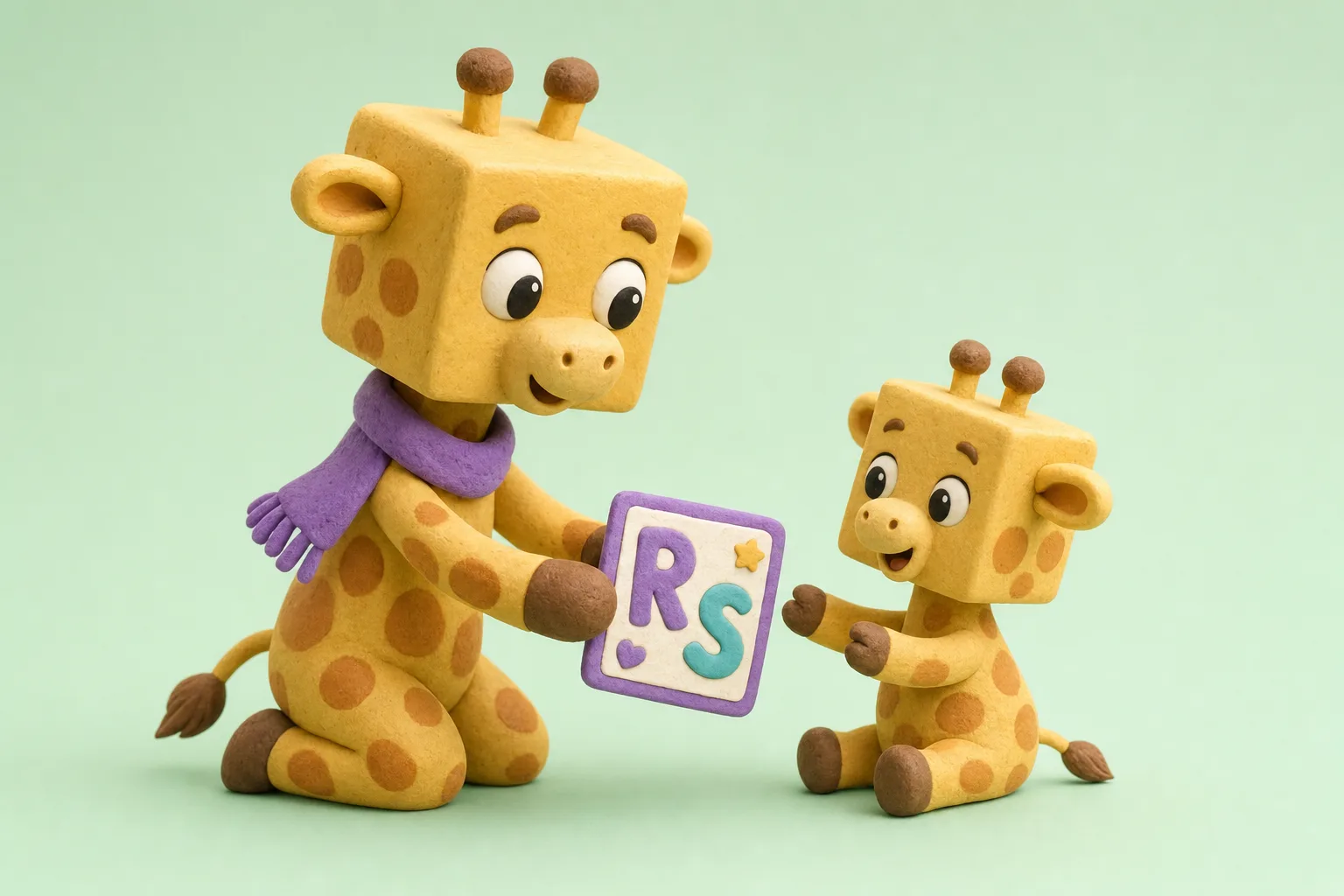
Age 5 is a hinge year: sentences are long enough for real stories, /s/ often still needs to tighten, /r/ may still be growing, and the ears are getting ready for letters. Parents then search for speech therapy exercises 5 year old advice: how do you practise R and S at home, and how do you prepare reading without copying school?
Below are eight exercises, drawing on parent intervention, dialogic reading and oral language as the base for later reading (Heidlage et al., 2020; Suttora et al., 2021; Whorrall & Cabell, 2016). LogiLand is practice software: short games. No diagnosis, no treatment plan, no substitute for a speech therapist.
Younger: age 2, age 3, age 4. Closer to school reading: age 6 and age 7. General: speech therapy exercises at home.
What's Typical at Age 5?
Averages, not a report card:
Language comprehension:
- Follows group conversation and stories
- Understands time words (yesterday, later) reasonably in context
- Picks up jokes and simple figurative language
Language production:
- Tells an event with beginning, middle and end
- Uses complex sentences ("I'm putting my coat on because it's raining")
- Vocabulary grows fast; new school words arrive
- Can explain how a game works
Articulation and listening:
- Strangers usually understand your child well
- /s/ is often present, but may still lisp or sound "slushy"
- /r/ is still developing for many children; at 5 that is not automatically atypical
- Hearing rhyme and first sounds (phonological awareness) is healthy preparation for reading
An /r/ that still sounds like /l/ or is missing is not, by itself, a reason to panic. It is a reason to see a therapist if intelligibility, /s/ or comprehension clearly lag, or if your child is suffering.
Do you use this with clients?
LogiLand is early access to digital home exercises. You assign them, the child practises at home, you see the progress.
Request early access8 playful speech therapy exercises for home
Keep sessions short. Five year olds notice immediately if you are "playing teacher".
1. S snake: air through a narrow gap
What you're practicing: /s/, listening for sharp noise
How to do it: Make a snake together: "ssss". Teeth close, air in the middle, no wet "th". Words: soup, sock, sun, bus. First the isolated /s/, then the word.
When: Short, 3 to 5 minutes, when your child is willing
Parent tip: Don't point at the teeth like an inspector. Model "sssoup" and continue the story.
2. R rumble: a trill can wait
What you're practicing: Listening for /r/, a start without pressure
How to do it: /r/ has variants (tongue tip, back of mouth). You model the /r/ you actually use. Words: red, rain, car, door. A motor sound ("rrr") can be play; it does not guarantee an adult /r/.
When: Songs, animals, cars
Parent tip: Don't force a tongue position from internet videos. The wrong drill can create tension. If in doubt: a speech therapist.
3. Rhyme tennis
What you're practicing: Phonological awareness (rhyme)
How to do it: You: "cat!" Child: "hat! mat! sat!" Near misses can be a laughing "almost", then you give a good example. Rhyme predicts later reading better than isolated letter knowledge at this age (Whorrall & Cabell, 2016).
When: Bike, car, waiting in a shop
Parent tip: No scoreboard. Training the ear is the goal.
4. Chop and stick
What you're practicing: Breaking words into syllables or first sounds
How to do it: Clap: "to-ma-to" (three claps). Or: "I hear sss in soup. Do you hear sss in sock too?" Not a spelling lesson; listening only.
When: Friends' names, shopping list
Parent tip: Stay with spoken language. Paper letters come later at school; here you build the ear.
5. A story with an S or R hero
What you're practicing: The sound in meaningful sentences, narrative
How to do it: Invent a short story: Sammy the snake or Rosie the robin. Each turn one sentence. You drop target words in without quizzing. Expansion stays the core strategy (Suttora et al., 2021).
When: Bedtime, or in the bath
Parent tip: Child says "The snake eats." You: "The snake eats slippery fish." Fun before perfection.
6. Dialogic reading with listening questions
What you're practicing: Comprehension, vocabulary, noticing sounds in words
How to do it: Pause: "Which word did you hear with sss?" or "Why is the bear wet?" Mix open questions with the occasional sound question so the book does not become a test.
When: Daily reading ritual
Parent tip: Follow what your child points at (Dunst et al., 2016). A conversation about one picture beats rushing ten pages.
7. First sound hunt in the house
What you're practicing: Auditory discrimination, a gentle lead in to letter sound links
How to do it: "Find three things that start with sss." Or rrr. Your child may point; you name. Later, if they ask, you can show the letter S or R, without pressure.
When: Tidy up, bedroom, kitchen
Parent tip: Start with the sound that is almost there. Success motivates more than the hardest sound first.
8. Explain how it works
What you're practicing: Complex sentences, sequence, school language
How to do it: "Explain how we make pancakes." Help with "first, then, after that". This is oral language that later feeds text comprehension (Whorrall & Cabell, 2016).
When: Cooking, building, explaining a game to a grandparent
Parent tip: Take the answer seriously. Fill in; don't correct the person.
The Power of Parent Language Stimulation
1. Expansion A longer, correct sentence beside theirs, no red pen.
2. Sounds in words, not in a vacuum /s/ in "soup" means something; a bare /s/ ten times is tough.
3. Phonological play is reading preparation Rhyme and first sounds are the bridge, not a replacement for later reading teaching.
4. Give /r/ time Many five year olds are still finding /r/. Separate "still ripening" from "stuck plus poor intelligibility".
5. Keep it playful Parent intervention works in daily interaction (Heidlage et al., 2020).
When Should You Involve a Speech Therapist?
Talk to someone if at age 5 your child:
- Is often unintelligible to classmates or strangers
- Keeps a strong lisp or lateral /s/ with no growth
- Has no /r/ at all and other sounds are weak too
- Still does not hear rhyme and first sounds after lots of play
- Cannot get stories going or misses instructions
- Develops speaking anxiety or teasing around "funny talking"
- Has hearing questions
- Loses language or sounds
A speech therapist listens to the whole system: articulation, language, fluency, hearing. LogiLand exercises are not treatment. Early, targeted help is more effective than years of waiting if something really is stuck (Guthrie et al., 2023; Singleton, 2018).
Practical Tips for Every Day
- No YouTube tongue gym as a protocol: with R and S, wrong tension is a risk
- Read every day: talk with the book beats a solo tablet
- Screen plus talk: recap, don't only watch (Sundqvist et al., 2021)
- One focus: a week of S words in play, not S and R and letters at once
- School and home: ask the teacher what they hear; that is useful information for a therapist
Conclusion: Ears First, Letters Later
The strongest reading preparation at 5 is rich spoken language plus listening play (Hatcher & Page, 2020; Whorrall & Cabell, 2016). You practise R and S in soup, socks and stories, not in a fight for the perfect sound.
Other ages: 2, 3, 4, 6, 7. For adults: speech therapy exercises for adults.
Frequently Asked Questions
Must /r/ already be right at 5? Often not. /r/ is a late sound. See a therapist if intelligibility or several sounds lag together.
Does a lisp always fade by itself? Sometimes yes, sometimes no. If /s/ stays between the teeth and people comment, screening is wise.
Is sound play the same as learning to read? No. It is the listening base. Real reading comes later, including in our age 6 article.
Does LogiLand replace a speech therapist? No. It is practice software. If you have concerns, make an appointment.
How many times a week? Two minutes of play every day beats one long Saturday session.
References
Dunst, C. J., Raab, M., & Hamby, D. W. (2016). Interest-based everyday child language learning. Revista de Logopedia, Foniatría y Audiología, 36(4), 153-161. https://doi.org/10.1016/j.rlfa.2016.07.003
Guthrie, W., Wetherby, A. M., Woods, J. J., Schatschneider, C., Holland, R. D., Morgan, L., & Lord, C. (2023). The earlier the better: An RCT of treatment timing effects for toddlers on the autism spectrum. Autism, 27(5), 1218-1234. https://doi.org/10.1177/13623613231159153
Hatcher, A., & Page, J. (2020). Parent-implemented language intervention for teaching Enhanced Milieu Teaching strategies to parents of low-socioeconomic status. Journal of Early Intervention, 42(4), 364-384. https://doi.org/10.1177/1053815120922906
Heidlage, J. K., Cunningham, J. E., Kaiser, A. P., Trivette, C. M., Barton, E. E., Frey, J. R., & Roberts, M. Y. (2020). The effects of parent-implemented language interventions on child linguistic outcomes: A meta-analysis. Early Childhood Research Quarterly, 50, 6-23. https://doi.org/10.1016/j.ecresq.2018.12.006
Singleton, N. C. (2018). Late talkers: Why the wait-and-see approach is outdated. Pediatric Clinics of North America, 65(1), 13-29. https://doi.org/10.1016/j.pcl.2017.08.018
Sundqvist, A., Koch, F. S., Birberg Thornberg, U., Barr, R., & Heimann, M. (2021). Growing up in a digital world: Digital media and the association with the child's language development at two years of age. Frontiers in Psychology, 12, 569920. https://doi.org/10.3389/fpsyg.2021.569920
Suttora, C., Zuccarini, M., Aceti, A., Corvaglia, L., Guarini, A., & Sansavini, A. (2021). The effects of a parent-implemented language intervention on late-talkers' expressive skills: The mediational role of parental speech contingency and dialogic reading abilities. Frontiers in Psychology, 12, 723366. https://doi.org/10.3389/fpsyg.2021.723366
Whorrall, J., & Cabell, S. Q. (2016). Supporting children's oral language development in the preschool classroom. Early Childhood Education Journal, 44(4), 335-341. https://doi.org/10.1007/s10643-015-0719-0
Do you use this with clients?
LogiLand is early access to digital home exercises. You assign them, the child practises at home, you see the progress.
Request early access